Innovation
New technology that finds better, faster and less costly ways to manage trees.
Innovation in arboriculture is part of how The Tree Consultancy Company works. Where new technology offers real benefits to our clients, we are quick to adopt it, often well ahead of the wider industry in New Zealand. That gives our team years of hands-on experience with the latest equipment and systems, and lets us deliver reliable, cost-efficient services.
We were the first arboricultural company in New Zealand to use ground penetrating radar for root detection, and the first to use Lidar to detect conflicts between trees and the road corridor. Our ongoing research is focused on finding new ways to reduce costs and improve efficiency for clients.
Our team has even designed and built a robot, ALISS, which takes high precision measurements for an ongoing research project. We also design and use custom data collection apps to suit individual projects, and we use atmospheric carbon sequestration rates of urban trees when prescribing replanting.
2014
First in NZ to map tree roots with ground penetrating radar
2017
First NZ arborists to survey road corridor trees with Lidar
100km
Of road corridor data collected in a matter of hours
40%
Cheaper than conventional survey methods on our Lidar project
The technology behind our surveys, assessments and design advice.
Light Detection and Ranging
Lidar uses laser light aimed at targets to measure distance. Vehicle-mounted Lidar and high resolution 360 degree camera footage make it quick and easy to survey trees and street furniture that encroach into the road corridor.
In 2017 we used Lidar to survey the canopy of trees along new double decker bus routes for Auckland Transport. It let us deliver the project:
Drone surveys
The most important parts of a tree are not always visible from the ground. We use drones to capture elevated and aerial views of individual trees and whole stands.
This gives us a clearer picture of the spatial relationships between trees, and lets us zoom in on features of particular interest, such as areas of potential failure high in the canopy.
Root mapping without digging
Ground penetrating radar (GPR) is widely used to locate underground services such as pipes and cables. In 2014 we became the first arboricultural company in New Zealand to use it to map the rooting profile of trees.
GPR lets us guide development design without disturbing the soil. There is no need to excavate, which in some cases needs its own consent and adds cost and delay. Roots can even be traced under road surfaces, with no digging or reinstatement, and the health and integrity of the tree are not compromised.
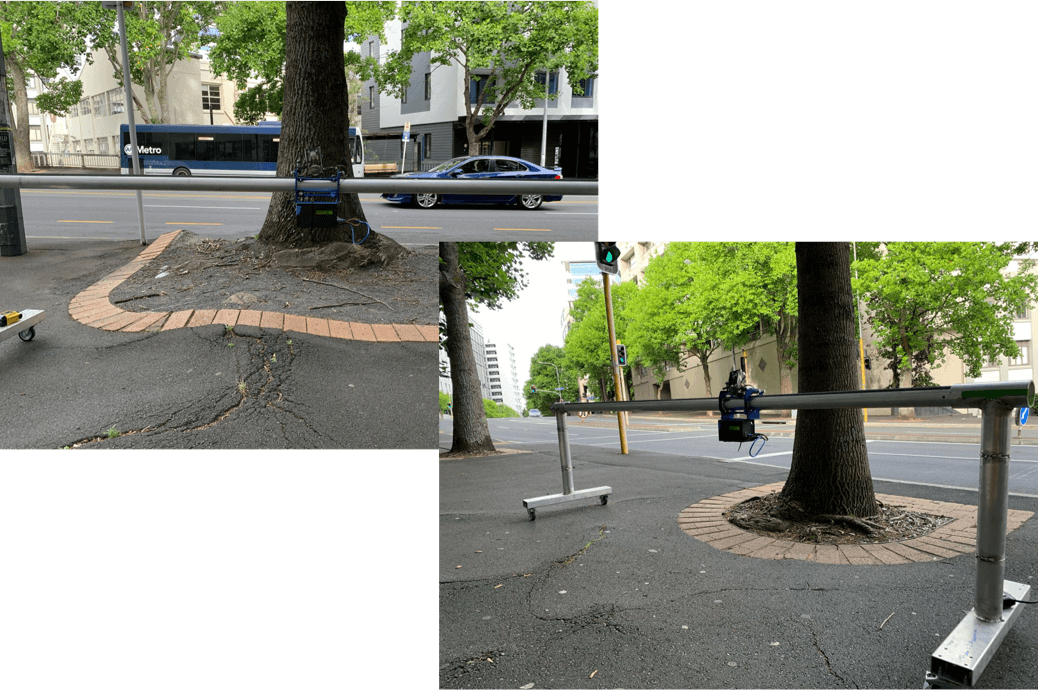
Automated Longitudinal Infrastructure Surface Scanner
ALISS is a robot our team designed and built to help get to the root cause of footpath deformation caused by trees. She takes high precision measurements of footpath surfaces as part of an ongoing research project.
With her data and some careful analysis, we aim to find out which combinations of trees and footpaths work well together and which do not. The results will help inform future tree planting decisions, so street trees and footpaths can both last longer.
Talk to us about what innovative survey methods could do for your tree management.
Contact Us